

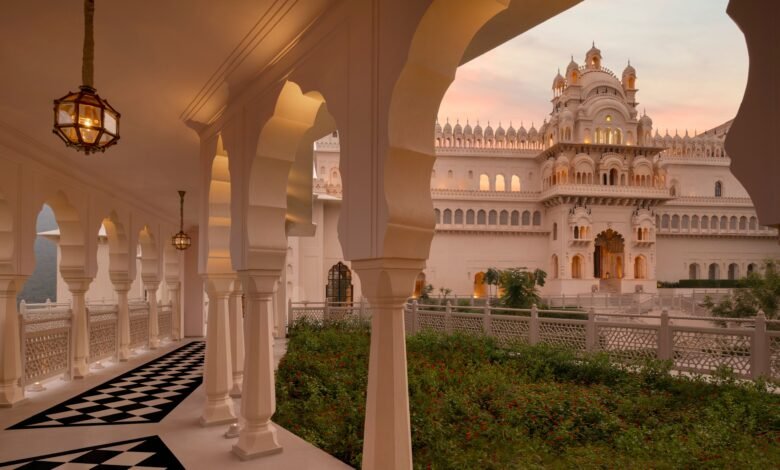
“It’s heaven,” my friend Anny said as the doors of the elevator opened, and the scalloped arches of an open-air walkway revealed themselves. As I took in the morning mist clinging to the lush, jungled mountainside beyond, I agreed that it was very beautiful. But Anny quickly clarified: “No, I mean—this place actually looks like heaven.”
You know what: She wasn’t wrong.
Through the gaps in the colonnade, under the tendrils of cloud hovering above the village of Rajgarh in India’s Madhya Pradesh region—the beating heart of the subcontinent’s center—the dramatic facade of the main palace beyond revealed itself. A 350-year-old fortress, it appeared, at least from a distance, as monumental and a little imposing. (I was immediately reminded of the hilltop palace from Indiana Jones and the Temple of Doom.) But after pulling up at the entrance and whizzing up in an elevator to somewhere in the middle of its cascading terraces, it revealed a more delicate beauty up close: its jharoka windows and balconies and temple-inspired sandstone turrets were as frilly and ornate as the decorative details on a wedding cake.
With sweeping views across the landscape extending—quite literally—as far as the eye could see, it really was how I pictured heaven (yes, actual heaven) while daydreaming as a kid. Thankfully, we hadn’t arrived at those pearly gates just yet. (Though a close encounter or two with a tiger while on safari over the following days could have had us fearing we were close.) Instead, we had crossed the threshold into Rajgarh Palace, the newest jewel in the Oberoi Group’s already pretty dazzling crown.
For those unfamiliar, the hospitality group was established
For those unfamiliar, the hospitality group was established by Mohan Singh Oberoi all the way back in 1934; across the decades, it’s established a reputation as India’s leading luxury hotel brand, with 14 properties scattered across the country, all renowned for their strategic locations—the only hotel with every room offering direct views onto the Taj Mahal, say, or situated on the banks of Lake Pichola in Udapiur overlooking the City Palace—as well as the unmatched warmth and attentiveness of its impeccably trained staff.
(In a country where traveling from one destination to another can be a little chaotic, an itinerary planned through Oberoi’s white-glove service is as smooth as freshly brewed chai.)
Still, Rajgarh Palace marks something of a pivot for the group. While they’re best known for the sleek contemporary architecture of their purpose-built resorts, in this instance, they spent seven years overseeing a meticulous—and, frankly, mind-boggling—restoration of this Bundela-era palace.
A crack team of historians, conservators, architects, and over 1,000 local artisans has returned its crumbling, overgrown courtyards and corridors to an even greater splendor than its former maharaja occupants could even have imagined. Yet while there’s plenty of razzle-dazzle—not least at night, when a system of thousands of uprights dramatically illuminate it against the night sky, turning its color from sandstone yellow to dusty pink—the overwhelming feeling here is one of utter calm.
We could sense it from the moment we
We could sense it from the moment we walked down that black-and-white checkerboard marble outdoor colonnade and into the lobby, where golden light fell in slats through the curved arch windows, illuminating the enormous chandelier of twinkling crystal and a corridor lavished with hand-painted murals of local flora and fauna. It continued as I was guided to my room, past the palace’s facade and up through the historic entryway flanked by two stone elephants, and to the inner courtyard, where the only sound was the gentle trickle of a shimmering square pool of water in the center.
And it could be felt most palpably within my suite, with its pale stuccoed walls, potted ferns, and watercolor paintings of historic Mughal scenes—incredibly opulent, sure, but not overbearing. That philosophy extends across the entire property, where there’s an impressive array of things to do: tours of its historic dungeons and staterooms, private yoga or meditation sessions by the lake, or just an afternoon by the sweeping infinity pool that hovers directly over the lake.
Which reminds me: the spa here—named Asmi after the Sanskrit word for “I am,” and housed within a cluster of tented pavilions at the far end of the lake—is an important pitstop, working within a newly conceived wellness philosophy for the group that incorporates modalities from breathwork to nutrition to traditional Ayurveda, but all whizzed up into a fresh, contemporary formula.
(Plus, they do a really excellent deep tissue
(Plus, they do a really excellent deep tissue massage, if that’s what you’re in the market for.)
What I enjoyed most of all, however, was simply wandering through the property’s 76 acres of hills and lakes and forests, which all feel very much alive and dictated by centuries-old rhythms: catching the scent of jasmine oil wafting over from the active Hanuman temple near the entrance, or the sound of cackling Indian roller birds fluttering around the trees and macaques rustling through the canopies.
(Adorable, sure, but take caution while walking from one area to another without a golf buggy, or they might just snatch your sunglasses.)
All of this, and I somehow haven’t got the food yet: the culinary offering here is as extensive and varied as the activities, particularly across the international menu at the lakeside restaurant of Neerangan, where you’ll find everything from perfectly charred sourdough pizza slathered in burrata and balsamic to spicy stir-fried prawns.
But it’s Maanya, the flagship restaurant housed within a dramatic dining room in the heart of the palace that features live sitar music every night, that was the most magnificent: its three high-concept tasting menus take inspiration from the historic dishes served in royal palaces centuries ago, acknowledging the global influence on Indian cuisine through both its extensive trade routes and its period as a British colony.
A Portuguese-style vindaloo was just the right amount
A Portuguese-style vindaloo was just the right amount of spicy and sour, while the desserts—we tried a perfectly steamed and springy bread pudding, among a few others—are universally exceptional. After feasting like Mughal royalty, you’ll need an early night—especially as the most popular activity here is a visit to Panna National Park, a tiger reserve known for being quieter and more tightly controlled (meaning, a greater likelihood of a spotting and fewer large canter vehicles with bigger groups to disrupt the experience) than its better-known competitor parks like Ranthambore or Bandhavgarh.
You’ll be picked up at the hotel entrance early in a Jeep to make the 15-minute trundle over to the park gates, then begin your journey through the dramatic landscapes of dusty red fields—then deeper into the jungle, where the park’s waterfalls and gorges lie. And, of course, its animals: we spotted deer, gray langurs, and vultures in quick succession, but what everyone really comes here for is to track down a Bengal tiger, so we traversed the rocky riverbeds and waterholes deeper inside the park in order to do just that.
(There’s a cheering backstory here, too: after the entire tiger population was wiped out in the late 2000s due to poaching, they’ve carefully managed the reintroduction of tigers over the past decade or so to bring the population back to around 100.)
As the morning drew on, however, the chances of seeing a tiger seemed to dwindle by the minute as the sun rose in the sky, and they retreated into the cooler shadows far from sight.
We heard the roar of another motor vehicle
Then, we heard the roar of another motor vehicle that had been informed of a sighting, and began a hair-raising chase down the park’s roads to find it—with the help of a pair of binoculars, I finally spotted it, loitering in the grasses by the river. It might not have been an up close and personal sighting—those are, after all, never guaranteed—but even just a glimpse of those iconic gold, white, and black striations from a distance was enough to deliver a jolt of the true thrill of the wild.
Given Oberoi’s sprawling reach across the Indian subcontinent, you’d be remiss not to tack on a stop at one or two of their other properties while visiting—as a result, I opted for a few nights in Delhi and Agra at the beginning. The Delhi property is housed within a colossal building from the 1960s nestled within the lush, tree-lined fairways of the Delhi Golf Club, directly overlooking the UNESCO World Heritage Site of Humayun’s Tomb; the journey to get there, chugging through the traffic-clogged streets to a deafening chorus of blasting horns, may feel a little chaotic, but once you step inside its revolving doors, all you’ll hear is the gentle hum of chatter and clinking teacups, or a piano tinkling in the background.
In 2018, the hotel received a multi-million-dollar, top-to-bottom redesign courtesy of Adam D. Tihany, resulting in a residential, unfussy aesthetic rather than the over-the-top stylings of some of the city’s high-end hotels. The rooms—blessed with crisp filtered air that serves as a stark contrast to the city smog—are vast and sun-drenched, layered with warm teak millwork, Italian marble, and subtle Mughal-patterned silks, with picture windows framing the terracotta-and-white domes of the tomb rising above the canopy.
Of course, there are the restaurants, which
Then, of course, there are the restaurants, which are as popular with well-to-do Delhiites as they are with hotel guests: highlights include the rooftop Baoshuan, which offers delicate dim sum under the guidance of Michelin-starred chef Andrew Wong, and Vineet Bhatia’s superb Dhilli on the ground floor, which churns out northern Indian classics—chaat with velvety dahi bhalla ice cream; crisp-skinned sea bass balanced with a silky, fragrant mango-coconut sauce; perfectly charred, tangy tandoori chicken, which was just about the best I’d ever eaten—with the utmost precision and care.
And if you do find yourself wanting to jump into the fray of the city, the concierge here (as ever, the service is top-notch) will happily whizz you around in a tuk-tuk to explore the spice markets or for a chauffeur-driven ride to soak up the city’s architectural history. Our next port of call was Agra, some four hours or so down the highway, to visit—what else?—the Taj Mahal.
And at The Oberoi Amarvilas, you’ll find probably the most impressive statement of the group’s cultural clout: located a mere 600 meters from the monument, the property was engineered so that every single guest room, suite, restaurant, and lounge boasts an uninterrupted, direct view of the world’s most famous tribute to love. There really is no other hotel that offers anywhere near the same kind of views, and stepping into the property’s tiered central courtyard—flanked by cascading fountains and reflecting pools inspired by Moorish and Mughal palace architecture—is like entering a private imperial court, a million miles away from the throngs of tourists milling outside.
Inside, the rooms lean into the opulence
Inside, the rooms lean into the opulence of their location, filled with hand-knotted silk carpets, mother-of-pearl inlaid furniture, and expansive private balconies where you can sip your morning coffee while watching the early dawn light wash the Taj’s marble dome in shades of blush and gold. Private golf buggies whisk you directly to the monument’s gates before the main crowds arrive, while evenings are best spent at Esphahan, listening to the trill of a live santur while enjoying Awadhi curries, followed by nightcaps on the terrace as the Taj glows softly under the starlight.
But if I’m being honest, despite the world-famous sights we saw in Delhi and Agra—the luminous marble of the Taj Mahal, the towering minarets of the Qutub Minar, the sprawling red sandstone ramparts of Agra Fort—nothing moved me quite like the wonders of Khajuraho. In particular, it was a visit on our final day to the Khajuraho monuments, a collection of Hindu and Jain temples that date back to the 10th century, that proved most affecting.
Set within a surprisingly peaceful park, our guide led us to examine the unfathomably intricate stone relief carvings that decorate the buff-colored sandstone temples at sunset, the deep shadows bringing them vividly back to life. The temples are most famous for their eye-popping erotic decorations—and we did take those sensual (and very acrobatic) canoodling couples in with a touch of amusement—but equally arresting were the depictions of gods and mortals engaged in the most quotidian acts: brushing their hair, applying kohl eyeliner, cradling infants, drinking wine, playing flutes, and in one particularly memorable example, bending gracefully to remove thorns from their feet.
These figures are from a thousand years ago,
These figures are from a thousand years ago, and lived on an entirely different continent from my own, yet I felt like I knew them. Recently, I was reading Maggie O’Farrell’s latest novel, Land, which talks at length about “thin places”—a concept rooted in Celtic mythology suggesting there are certain locales where the veil between worlds is especially close, or fragile, or where you feel just that little bit closer to the realm of the divine.
There was something about the temples of Khajuraho before the gates to the park closed, as we wandered between these monuments whose wildly imaginative carvings and powerful understanding of the universal truths of human nature, that truly felt that way. And without wishing to sound overdramatic, or too gushing, it’s a sense I had at Rajgarh Palace, where you spend most mornings up in the clouds before the mists part and reveal the bucolic landscapes beyond.
When my friend said it felt like heaven? Well, she was exactly right. The whole stay did, in fact.
Source: www.vogue.com